android dsl-json,GitHub - ceeker/dsl-json: DSL Platform compatible JSON library
DSL-JSON library
Fastest JVM (Java/Android/Scala/Kotlin) JSON library with advanced compile-time databinding support. Compatible with DSL Platform.
Java JSON library designed for performance. Built for invasive software composition with DSL Platform compiler.
Distinguishing features
supports external schema - Domain Specification Language (DSL)
works on existing POJO classes via annotation processor
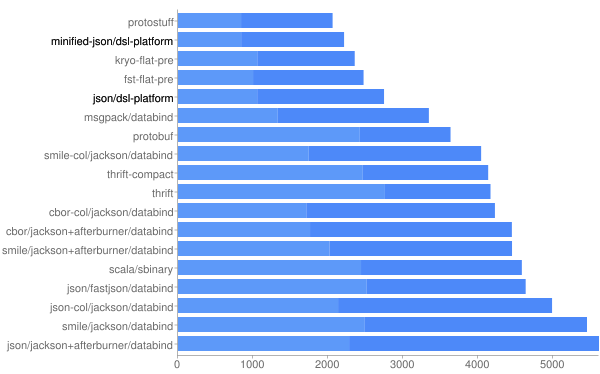
performance - faster than any other Java JSON library. On pair with fastest binary JVM codecs
works on byte level - deserialization can work on byte[] or InputStream. It doesn't need intermediate char representation
extensibility - custom types can be registered for serialization/deserialization
streaming support - large JSON lists support streaming with minimal memory usage
zero-copy operations - converters avoid producing garbage
minimal size - runtime dependency weights around 200KB
no unsafe code - library doesn't rely on Java UNSAFE/internal methods
legacy name mapping - multiple versions of JSON property names can be mapped into a single POJO using alternativeNames annotation
binding to an existing instance - during deserialization an existing instance can be provided to reduce GC
advanced annotation processor support - support for Java-only compilation or DSL Platform integration via conversion of Java code to DSL schema
customizable runtime overheads - works in reflection mode, in Java8 annotation processor mode or DSL Platform mode. Schema and annotation based POJOs are prepared at compile time
support for other library annotations - Jackson annotations will be used and compile time analysis can be extended in various ways
Scala types support - Scala collections, primitives and boxed primitives work without any extra annotations or configuration
Kotlin support - annotation processor can be used from Kotlin. NonNull annotation is supported
JsonB support - high level support for JsonB String and Stream API. Only minimal support for configuration
Schema based serialization
DSL can be used for defining schema from which POJO classes with embedded JSON conversion are constructed.
This is useful in large, multi-language projects where model is defined outside of Java classes.
More information about DSL can be found on DSL Platform website.
@CompiledJson annotation
Annotation processor works by analyzing Java classes and it's explicit or implicit references.
Processor outputs encoding/decoding code/descriptions at compile time.
This avoids the need for reflection, provides compile time safety and allows for some advanced configurations.
Processor will register optimized converters into META-INF/services.
This will be loaded during DslJson initialization with ServiceLoader.
Converters will be created even for dependent objects which don't have @CompiledJson annotation.
This can be used to create serializers for pre-existing classes without annotating them.
Java8 annotation processor
Since v1.7.0 DSL-JSON supports compile time databinding without Mono/.NET dependency.
It provides most features and flexibility, due to integration with runtime analysis and combining of various generic analysis.
Bean properties, public fields and classes without empty constructor are supported.
To use Java8 annotation processor its sufficient to just reference Java8 version of the library:
com.dslplatform
dsl-json-java8
1.7.4
For use in Android, Gradle can be configured with:
dependencies {
compile 'com.dslplatform:dsl-json-java8:1.7.4'
annotationProcessor 'com.dslplatform:dsl-json-java8:1.7.4'
}
DSL Platform annotation processor
DSL Platform annotation processor requires .NET/Mono to create databindings.
It works by translating Java code into equivalent DSL schema and running DSL Platform compiler on it.
Since v1.7.2 Java8 version has similar performance, so the main benefit is ability to target Java6.
Bean properties, public non-final fields and only classes with empty constructor are supported.
Annotation processor can be added as Maven dependency with:
com.dslplatform
dsl-json-processor
1.7.4
provided
For use in Android, Gradle can be configured with:
dependencies {
compile 'com.dslplatform:dsl-json:1.7.4'
annotationProcessor 'com.dslplatform:dsl-json-processor:1.7.4'
}
Project examples can be found in examples folder
Java/DSL property mapping
Java type
DSL type
Java type
DSL type
int
int
byte[]
binary
long
long
java.util.Map
properties?
float
float
java.net.InetAddress
ip?
double
double
java.awt.Color
color?
boolean
bool
java.awt.geom.Rectangle2D
rectangle?
java.lang.String
string?
java.awt.geom.Point2D
location?
java.lang.Integer
int?
java.awt.geom.Point
point?
java.lang.Long
long?
java.awt.image.BufferedImage
image?
java.lang.Float
float?
android.graphics.Rect
rectangle?
java.lang.Double
double?
android.graphics.PointF
location?
java.lang.Boolean
bool?
android.graphics.Point
point?
java.math.BigDecimal
decimal?
android.graphics.Bitmap
image?
java.time.LocalDate
date?
org.w3c.dom.Element
xml?
java.time.OffsetDateTime
timestamp?
org.joda.time.LocalDate
date?
java.util.UUID
uuid?
org.joda.time.DateTime
timestamp?
Java/DSL collection mapping
Java type
DSL type
array
Array
java.util.List
List
java.util.Set
Set
java.util.LinkedList
Linked List
java.util.Queue
Queue
java.util.Stack
Stack
java.util.Vector
Vector
java.util.Collection
Bag
Collections can be used on supported Java types, other POJOs and enums.
Other collections/containers
Java8 supports all kinds of collections, even maps and Java8 specific container such as Optional.
Custom types in compile-time databinding
Types without builtin mapping can be supported in three ways:
by implementing JsonObject and appropriate JSON_READER
by defining custom conversion class and annotating it with @JsonConverter
by defining custom conversion class and referencing it from property with converter through @JsonAttribute
Custom converter for java.util.Date can be found in example project
Annotation processor will check if custom type implementations have appropriate signatures.
Converter for java.util.ArrayList can be found in same example project
@JsonConverter which implements Configuration will also be registered in META-INF/services which makes it convenient to setup initialization.
All of the above custom type examples work out-of-the-box in Java8 version of the library.
@JsonAttribute features
DSL-JSON property annotation supports several customizations/features:
name - define custom serialization name
alternativeNames - different incoming JSON attributes can be mapped into appropriate property. This can be used for simple features such as casing or for complex features such as model evolution
ignore - don't serialize specific property into JSON
nullable - tell compiler that this property can't be null. Compiler can remove some checks in that case for minuscule performance boost
mandatory - mandatory properties must exists in JSON. Even in omit-defaults mode. If property is not found, IOException will be thrown
index - defines index order used during serialization or can be used for array format
hashMatch - DSL-JSON matches properties by hash values. If this option is turned off exact comparison will be performed which will add minor deserialization overhead, but invalid properties with same hash names will not be deserialized into "wrong" property. In case when model contains multiple properties with same hash values, compiler will inject exact comparison by default, regardless of this option value.
converter - custom conversion per property. Can be used for formatting or any other custom handling of JSON processing for specific property
typeSignature - disable inclusion of $type during abstract type serialization. By default abstract type will include additional information which is required for correct deserialization. Abstract types can be deserialized into a concreted type by defining deserializeAs on @CompiledJson which allows the removal of $type during both serialization and deserialization
External annotations
For existing classes which can't be modified with @JsonAttribute alternative external annotations are supported:
Nullability annotations
During translation from Java objects into DSL schema, existing type system nullability rules are followed.
With the help of non-null annotations, hints can be introduced to work around some Java nullability type system limitations.
List of supported non-null annotations can be found in processor source code
Property aliases
Annotation processor supports external annotations for customizing property name in JSON:
com.fasterxml.jackson.annotation.JsonProperty
com.google.gson.annotations.SerializedName
Those annotations will be translated into specialized DSL for specifying serialization name.
Ignored properties
Existing bean properties and fields can be ignored using one of the supported annotations:
com.fasterxml.jackson.annotation.JsonIgnore
org.codehaus.jackson.annotate.JsonIgnore
Ignored properties will not be translated into DSL schema.
Required properties
Jackson required = true can be used to fail if property is missing in JSON:
Serialization modes
Library has several serialization modes:
minimal serialization - omits default properties which can be reconstructed from schema definition
all properties serialization - will serialize all properties from schema definition
array format - object will be serialized as array without property names
Best serialization performance can be obtained with combination of minimal serialization and minified property names/aliases or array format.
Benchmarks
Independent benchmarks can validate the performance of DSL-JSON library:
JVM serializers - benchmark for all kind of JVM codecs. Shows DSL-JSON as fast as top binary codecs
Kostya JSON - fastest performing Java JSON library
JMH JSON benchmark - benchmarks for Java JSON libraries
Reference benchmark (built by library authors):
.NET vs JVM JSON - comparison of various JSON libraries
Dependencies
Core library (with analysis processor) and DSL Platform annotation processor targets Java6.
Java8 library includes runtime analysis, reflection support, annotation processor and Java8 specific types. When Java8 annotation processor is used Mono/.NET doesn't need to be present on the system.
Library can be added as Maven dependency with:
com.dslplatform
dsl-json
1.7.4
Runtime analysis
Java8 library has builtin runtime analysis support, so library can be used even without compile time databinding
or it can just add additional runtime support alongside compile-time databinding (default behavior).
Runtime analysis is required for some features such as generics which are not known at compile time.
Runtime analysis works by lazy type resolution from registered converters, eg:
private final DslJson.Settings settings = runtime.Settings.withRuntime().includeServiceLoader();
private final DslJson json = new DslJson(settings);
Best practices
Reusing reader/writer.
JsonWriter It has two modes of operations:
populating the entire output into byte[]
targeting output stream and flushing local byte[] to target output stream
JsonWriter can be reused via reset methods which binds it to specified target.
When used directly it should be always created via newWriter method on DslJson instance.
Several DslJson serialize methods will reuse the writer via thread local variable.
When using JsonWriter via the first mode, result can be copied to stream via .toStream(OutputStream) method.
DslJson json = ... // always reuse
OutputStream stream = ... // stream with JSON in UTF-8
json.serialize(pojo, stream); //will use thread local writer
JsonReader can process byte[] or InputStream inputs. It can be reused via the process methods.
When calling DslJson deserialize methods often exists in two flavors:
with byte[] argument, in which case a new JsonReader will be created, but for best performance byte[] should be reused
without byte[] argument in which case thread local reader will be reused
For small messages it's better to use byte[] API. When reader is used directly it should be always created via newReader method on DslJson instance.
DslJson json = ... // always reuse
InputStream stream = ... // stream with JSON in UTF-8
POJO instance = json.deserialize(POJO.class, stream); //will use thread local reader
Binding
JsonReader has iterateOver method for exposing input collection as consumable iterator.
Also, since v1.5 binding API is available which can reuse instances for deserialization.
DslJson json = new DslJson(); //always reuse
byte[] bytes = "{\"number\":123}".getBytes("UTF-8");
JsonReader reader = json.newReader().process(bytes, bytes.length);
POJO instance = new POJO(); //can be reused
POJO bound = reader.next(POJO.class, instance); //bound is the same as instance above
Limits
Library has various limits built-in to protect against malicious input:
Scala support
Scala types can be used. They will be analyzed at runtime with. Scala specific behaviour:
Option[_] - means that JSON attribute can be null. If type is not an Option and null is found, IOException will be thrown
Container[Primitive] - eg: Option[Int] - will behave as Option and thus it will avoid wrong type decoding issues
name: Type = Default - will be used to imply if attribute can be omitted from JSON - in which case the specified default value will be used (default values are static at analysis time)
tuples - will be encoded/decoded in Array format (without property names)
To avoid some Java/Scala conversion issues it's best to use Scala specific API via
import com.dslplatform.json._ // import pimping
val dslJson = new DslJson[Any]()
//use encode pimp to correctly analyze types (this will mostly provide some performance benefits)
dslJson.encode(instance, ...)
//use decode pimp to correctly analyze types (this will avoid some issues with nested classes and missing metadata)
val result = dslJson.decode[TargetType](...)
For SBT dependency can be added as:
libraryDependencies += "com.dslplatform" %% "dsl-json-scala" % "1.7.4"
Kotlin support
Kotlin has excellent Java interoperability, so annotation processor can be used as-is.
When used with Gradle, configuration can be done via:
apply plugin: 'kotlin-kapt'
dependencies {
compile "com.dslplatform:dsl-json-java8:1.7.4"
kapt "com.dslplatform:dsl-json-java8:1.7.4"
}
FAQ
Q: What is TContext in DslJson and what should I use for it?
A: Generic TContext is used for library specialization. Use DslJson when you don't need it and just provide null for it.
Q: Why is DSL-JSON faster than others?
A: Almost zero allocations. Works on byte level. Better algorithms for conversion from byte[] -> type and vice-versa. Minimized unexpected branching. Reflection version is comparable with Jackson performance. Extra difference comes from compile-time databinding.
Q: DslJson is failing with unable to resolve reader/writer. What does it mean?
A: During startup DslJson loads services through ServiceLoader. For this to work META-INF/services/com.dslplatform.json.Configuration must exist with the content of dsl_json_Annotation_Processor_External_Serialization or dsl_json.json.ExternalSerialization which is the class crated during compilation step. Make sure you've referenced processor library (which is responsible for setting up readers/writers during compilation) and double check if annotation processor is running. Refer to example projects for how to set up environment.
Q: Maven/Gradle are failing during compilation with @CompiledJson when I'm using DSL Platform annotation processor. What can I do about it?
A: If Mono/.NET is available it should work out-of-the-box. But if some strange issue occurs, detailed log can be enabled to see what is causing the issue. Log is disabled by default, since some Gradle setups fail if something is logged during compilation. Log can be enabled with dsljson.loglevel processor option
Q: DSL Platform annotation processor checks for new DSL compiler version on every compilation. How can I disable that?
A: If you specify custom dsljson.compiler processor option or put dsl-compiler.exe in project root it will use that one and will not check online for updates
Q: What is this DSL Platform?
A: DSL Platform is a proprietary compiler written in C#. Since v1.7.0 DSL Platform is no longer required to create compile-time databinding. Compiler is free to use, but access to source code is licensed. If you need access to the compiler or need performance consulting let us know

华为开发者空间,是为全球开发者打造的专属开发空间,汇聚了华为优质开发资源及工具,致力于让每一位开发者拥有一台云主机,基于华为根生态开发、创新。
更多推荐


 0
0 0
0- 0


 已为社区贡献3条内容

所有评论(0)